

There are numerous means of assessing the impact of Europe’s uncoordinated response to two recent and major events that are impacting the economy as well as reshaping the geopolitical arena: covid-19 and to the Special Military Operation under way in parts of Ukraine. From a purely economic perspective it is relatively easy. As far as covid-19 is concerned, one may look at things like drop in GDP, increased unemployment, number of businesses that have been forced to close, loss of revenue, reduction of international trade and travel. As for Ukraine, we can speak of the dramatic increase in the cost of energy due to the sanctions imposed on the Russian Federation. These sanctions have backfired and damaged more Europe and its economy that that of Russia. From a geopolitical perspective, Russia and the BRICS block has been strengthened very significantly, reducing, at the same time, Europe’s footprint on global politics and on the global economy.
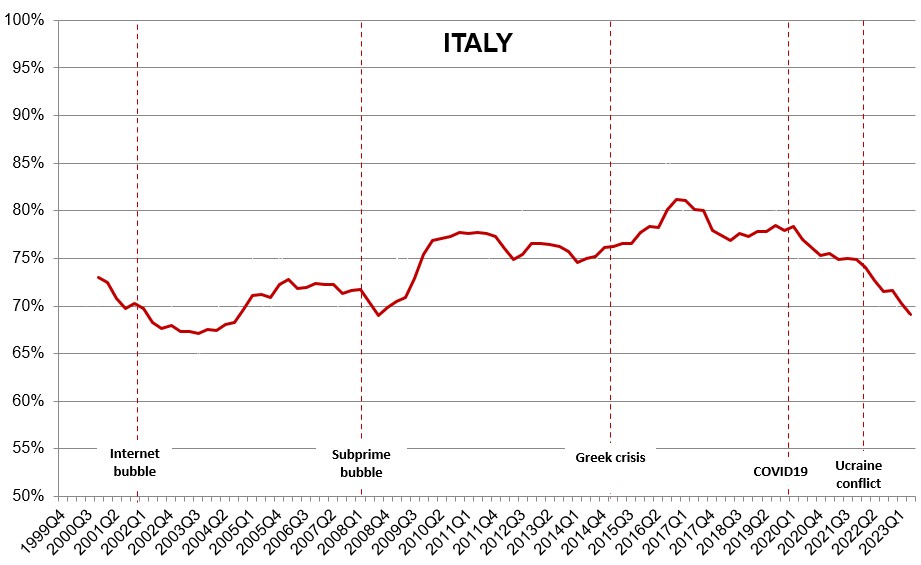
A different way to measure the said impact is to look at the evolution of resilience of some of Europe’s leading economies. Based on EUROSTAT’s GDP data, released in Q2 2023, we have analysed the resilience of Italy, Germany and France. The results are shown below.
ITALY
GERMANY

FRANCE

It is evident that Italy’s resilience variation since Q1 2020 has been the most dramatic. We are speaking of a massive drop of 12%. There is no indication that the trend is going to change. So much for the National Recovery and Resilience Plan! What is surprising is that in the period 2015-2017, Italy had the highest resilience of 80%, far more than France and Germany.
In the case of Germany, the reduction is 7% while in the case of France it is a mere 3%. France depends far more on nuclear energy that other European countries, which are forced to buy oil and gas, hence it is more immune to the cost of energy. However, as is the case of Italy, France’s resilience too is still dropping.
As for Germany, its resilience is becoming visibly more volatile, with pronounced swings. It just goes to show that the economy has large inertia and complex dynamics.
The above analyses are very simplistic and are based on two dozen GDP-specific parameters extracted from EUROSTAT.
NB. Resilience is not a measure of performance. It is a measure of resistance to shocks.
 Artificial Intuition
0 comments on “Measuring the Impact of EU’s Response to Covid-19 and Ukraine Conflict”