

The rate of improvement of Artificial Intelligence technology has not been as expected. Gullible, inexperienced public (and many investors) is often made to think – thanks to crafty advertising and hype – that once a breakthrough has been achieved, progress and improvement will be exponential. Instead, in most cases progress proceeds at logarithmic pace. AI startups often fake their demos. Once this sinks in, the bubble bursts.
Beyond the slower than expected progress, one of the issues with AI is that of explainability and accountability. The danger stemming from using and trusting a super complex black box cannot be overstated, as indicated is a recent article in Forbes. Not to mention the fact that AI sometimes fails in a strepitous way. While recognizing that the image of a five-legged elephant is clearly wrong, there are numerous cases where mistakes can only be noticed by an expert. In effect, AI can be a very powerful tool, but not in the hands of a fool.
The internet is constantly being filled with AI-generated content, which, in turn is used for further training. It is clear what the consequences of that can be. Feeding back flawed data into a training loop inevitably compounds the problem. As the entire ecosystem composed of the internet with all its content, and Generative AI tools that thrive on it, becomes more complex, all of the above issues are elevated to a totally new level. In fact, AI companies today are having problems with monetizing on the technology. A recent article even claims that this is AI’s biggest problem.
How can Artificial Intuition help AI?
A huge cost of running an AI business is computational cost (cost of the actual hardware and energy). Huge HW resources are needed to train AI. This is because the amount of training data that needs to be processed is astronomical. How can one reduce this amount of data? Artificial Intuition is based on second generation Quantitative Complexity Management, the so-called QCM2. It can measure the complexity of things. Complexity, on the other hand, is structured information. The idea, therefore, is to
measure the complexity of training vectors and use only the information-rich ones, i.e., the most complex ones
This can reduce the size of the training set considerably, reducing HW and electricity needs.
Another contribution of Artificial Intuition to AI is to help filter out solutions of extreme complexity as well as the trivial ones, i.e., the unlikely ones. The concept is illustrated below.
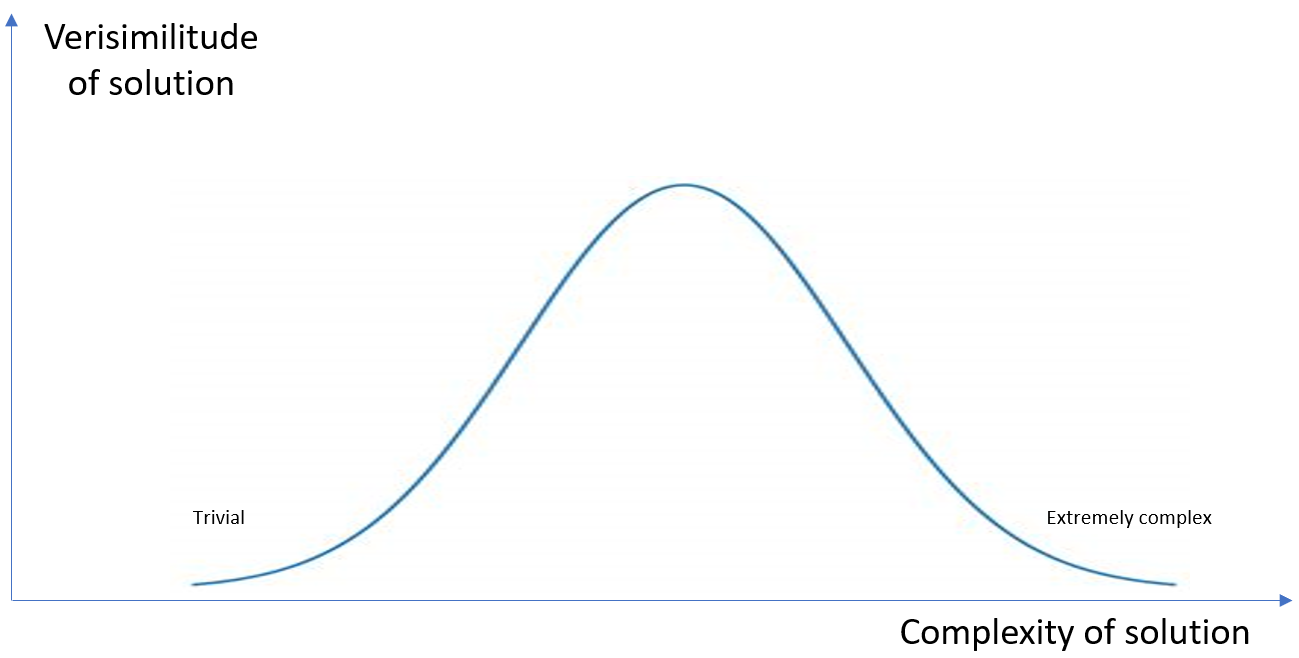
Suppose an AI system produces a solution to a request. Suppose that the request is modified a number of times, producing as many results. Which one is good? While this in itself may be a difficult question, QCM2 can help
discard the trivial solutions as well as the overly complex ones
Spotting such solutions is not easy, except in trivial cases! While human intuition is able to ‘feel’ that something is highly complex, it can also be misleading. As we know, intuition works in the case of a very small number of dimensions.
Imagine a new AI chip that does the Artificial Intuition bit too
Adding a human touch to Artificial Intelligence will make it less artificial and more intelligent.
 Artificial Intuition
0 comments on “How Artificial Intuition Can Help Artificial Intelligence.”