
Before reading this blog, please read here.
The analysis has been running since January 2024. The situation as of September 2024 is illustrated below.
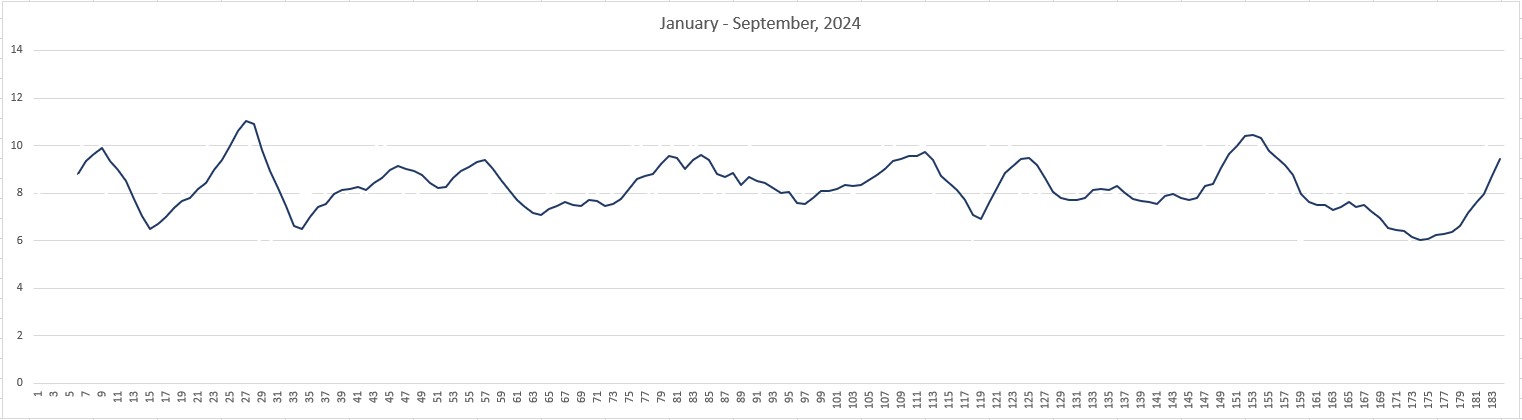
As stated in the mentioned blog, while complexity oscillates, its mean shows no drift or appreciable changes in value. This points to a system that oscillates around a certain condition of ‘equilibrium’ and one which is stable. Diverging complexity could point to a sort of runaway, but it is too early to say.
The Earth’s atmosphere is clearly not a closed system since it receives energy from the Sun, cosmic radiation and energy of geothermal nature as well as energy of anthropogenic nature. As far as mass is concerned, about 40.000 metric tons of interplanetary matter strike the Earth’s atmosphere, with a small portion actually hitting the ground. In addition, hydrogen and helium loss is around 90.000 metric tons per year. This means that Earth’s mass is, for all practical purposes, constant.
Of all the energy the Earth manages, some is radiated into space, some is held in the oceans and in the atmosphere. This energy management is a complex, dynamic process which produces one hugely important result – it maintains the Earth’s average temperature constant over periods of thousands of years. This could point to some sort of energy conservation in the system ‘oceans + atmosphere’, even though the system is not closed.
It is far to early to formulate a proper scientific hypothesis in this sense but what our analyses could point to is some form of ‘complexity conservation‘. Since our complexity computations are based on temperatures, we could imagine that under certain conditions, an ‘energy and complexity conservation principle‘ could be conceived. This makes sense in that complexity is a measure of information (mainly that which derives from the presence of structure) and information is necessary to enable the use of energy in order to perform work. Work, on the other hand, may lead to the generation of new structure (complexity). Therefore, energy, work and complexity seem to be interrelated.
 Artificial Intuition
0 comments on “Complexity and Measuring the Climate – an Update”