

There exist numerous high-complexity scenarios and contexts in which it is necessary to make fast, often critical and strategic decisions. For example:
- Battle management
- Disaster and emergency management
- Trajectory planning (drones, missiles)
- Autonomous vehicles
- Policy planning
Some of the above imply real-time action, for example battle management, or trajectory modification in autonomous systems.
However, there are three key issues when any of the above takes place in the presence of high complexity:
- In highly complex situations, the number of outcomes can be immense. The higher the complexity, the greater the number of possible states.
- There rarely are sufficient examples from which to learn (via Machine Learning) and identify the type of situation or threat one is dealing with. Sometimes there may be no examples at all as one may be facing a unique situation that appears suddenly.
- There may be very little time, and a decision must be made regardless.
In such cases, one often relies on experience or gut feeling. This is evidently extremely subjective. Artificial Intuition can help.
Artificial Intuition is computational gut feeling
Artificial Intuition works as follows:
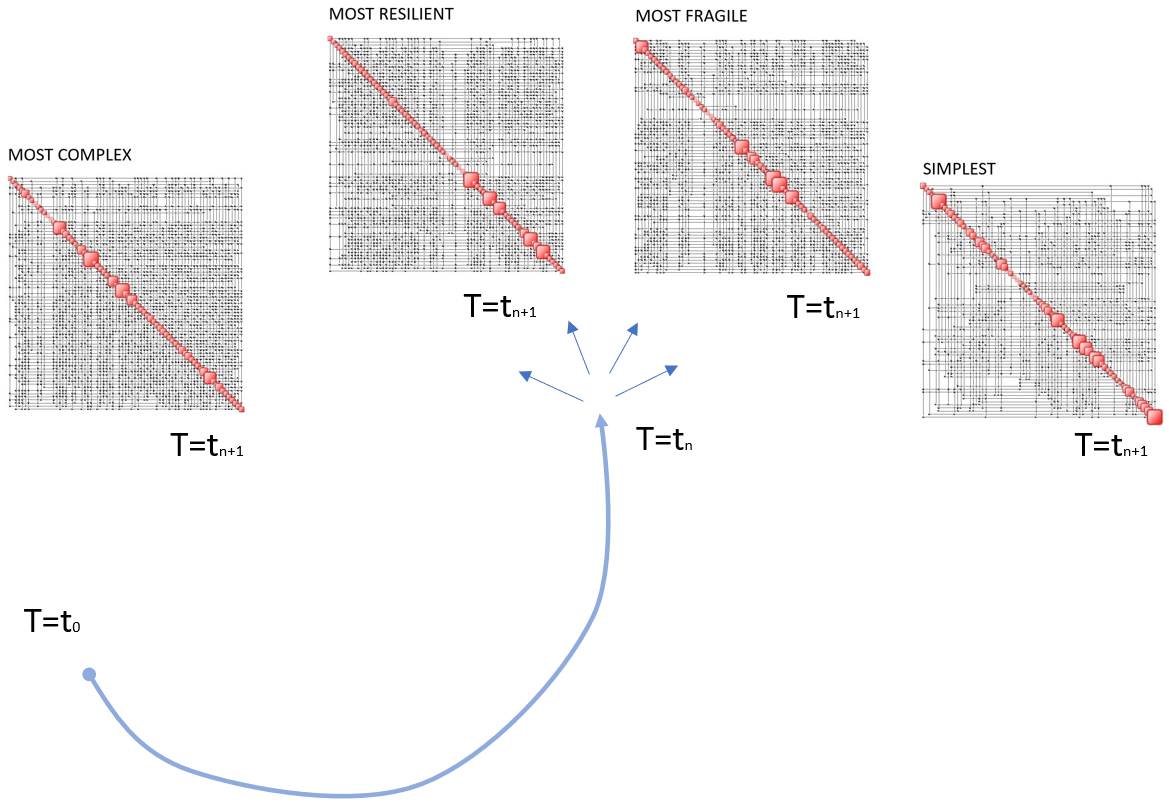
Currently available data reflecting a given situation, spanning the last few seconds, minutes or hours, is processed at time T=t_n (data is normally produced and processed at discrete time intervals). Artificial Intuition generates all possible scenarios (outcomes) at time T=t_n+1. As mentioned, the number of such outcomes can be large. In any case, out of all the possible outcomes the system identifies the following:
- Most complex
- Simplest
- Most resilient
- Most fragile
This is illustrated in the figure below.
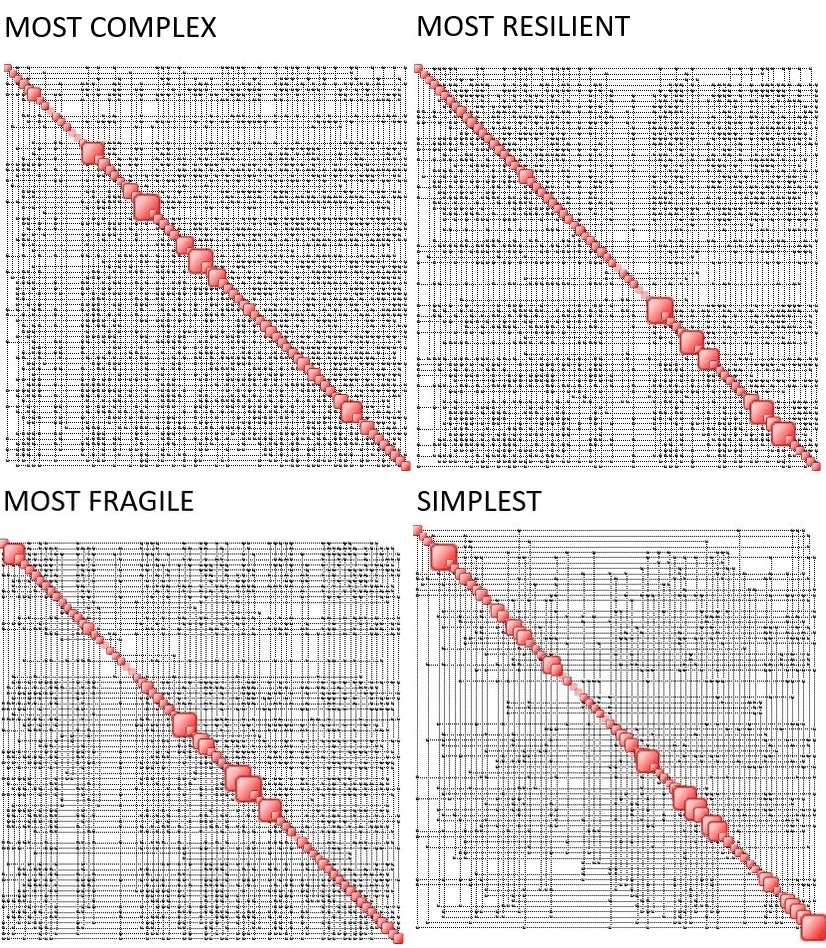
One then must make the decision which way to go. Typically, the worst case scenario is one that is, at the same time, highly complex and fragile. Presumably, one would opt for a solution that is a blend of simplicity and resilience. Examples of the Complexity Maps corresponding to the above four outcomes are shown below
There are different ways to select a scenario that would ‘optimally’ blend simplicity and resilience out of the multitude of possible outcomes. Here the QCM2 (second generation Quantitative Complexity Management) comes into the picture, but that is a different matter. What is important is that Artificial Intuition is able to:
- Build a Complexity-Resilience Envelope (CRE)
- Do so without Machine Learning
Below is an example of a Complexity-Resilience Envelope. Keep in mind that this envelope changes at each step (time interval).
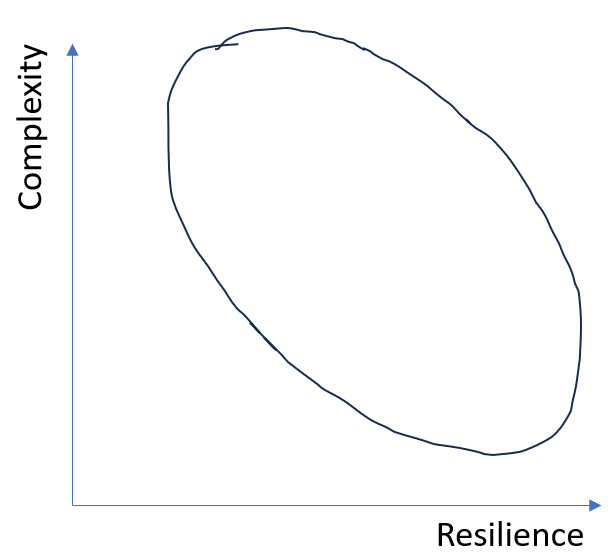
The CRE can take on many forms. The one in the above sketch is just one example of convex envelope. Non-convex envelopes are more problematic.
An example of envelope is shown below:
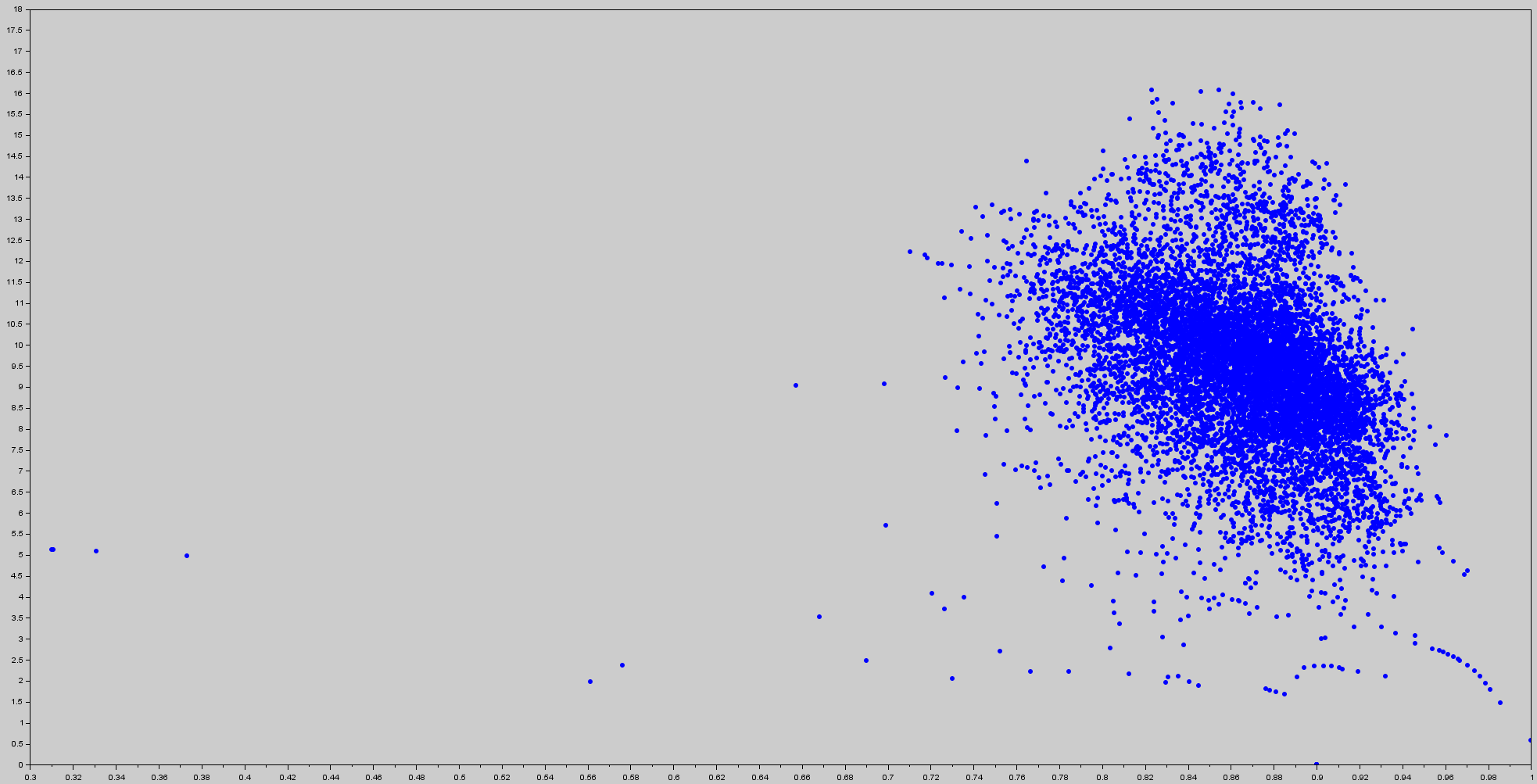
The point however remains the same: where to position oneself within the envelope in the next few seconds? Where is the best location? What is best?
 Artificial Intuition
0 comments on “Artificial Intuition: 4-th Generation AI for Fast, Critical Decision-Making”