
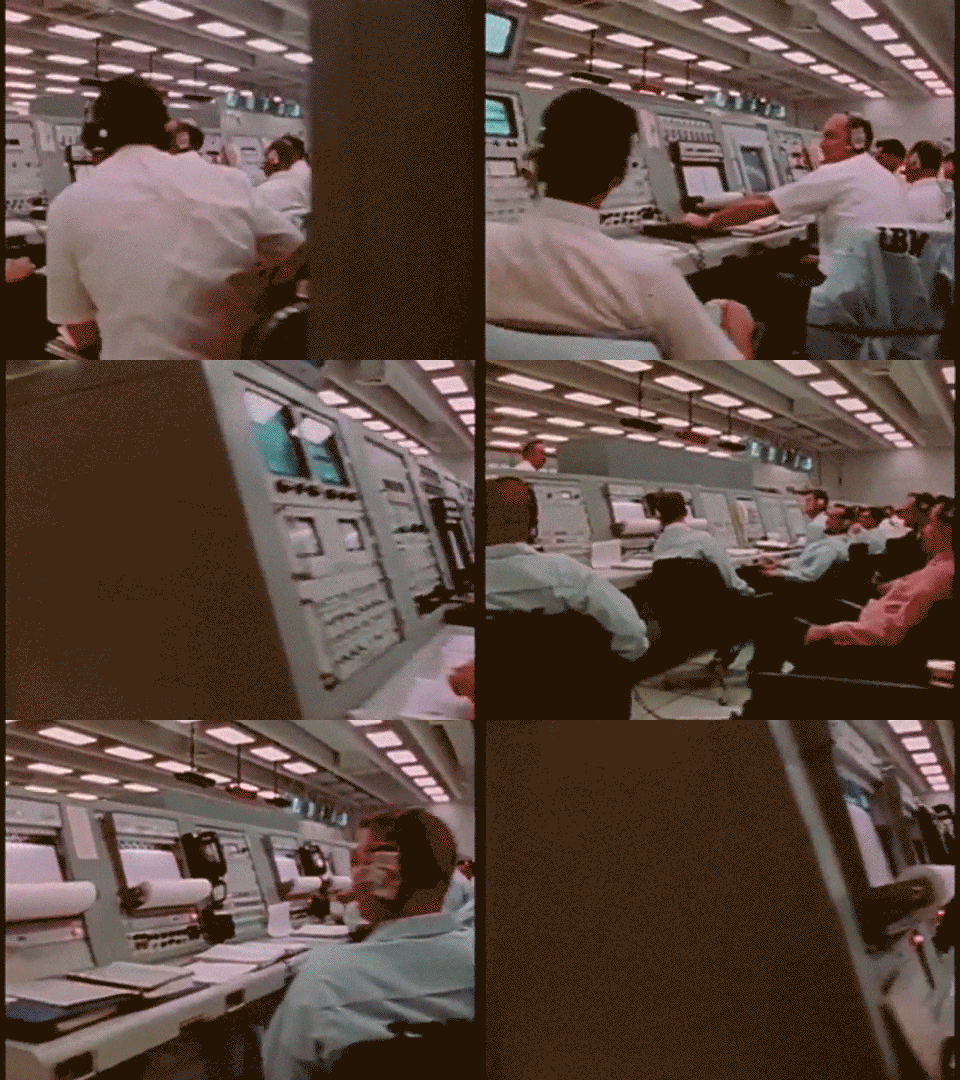
“Telemetry is the in situ collection of measurements or other data at remote points and their automatic transmission to receiving equipment (telecommunication) for monitoring. The word is derived from the Greek roots tele, ‘far off’, and metron, ‘measure’. Systems that need external instructions and data to operate require the counterpart of telemetry: telecommand.” Wikipedia.
The goal of telemetry is to monitor the state of health (SOH) of a given system, such as spacecraft, aircraft, drone or any other autonomous device. The assessment of state of health may be done onboard (edge computing) or in situ, but, at the same time, data may be transmitted to a remote location for further, more detailed analysis. This can be the case of cars, trains, oil rigs, ships, etc.
In either case, the goal is not only just the storage of historical data (often due to specific regulations) but for control and/or correction purposes and decision making. An equally important reason for data collection is to use it in real time for anomaly or malfunction detection.
An advanced anomaly detection capability is offered by Artificial Intuition, which is powered by our second-generation QCM technology (the QCM2). The idea is to sample telemetry data (extracting data frames) at a given rate and process it with Artificial Intuition in real time, providing anomaly pre-alarms. The is done of course without interference with conventional SOH monitoring. The general scheme is illustrated below.

Incorporating Artificial Intuition capability into a telemetry and/or SCADA (supervisory control and data acquisition) infrastructure is easy due to a very simple I/O protocol.
However, the key characteristic of Artificial Intuition is that it does not require Machine Learning. There is no need to come up with a list of possible anomalies and then to provide a sufficiently large number of examples of each one in order to learn to recognize them. Complex systems, such as the ones depicted above, have the unpleasant urge to generate very rare and non-intuitive anomalies at the worst possible time and circumstances (ever heard of Murphy’s Laws?). Learning to recognize all possible anomalies is a monumental, not to say impossible task.
The higher the complexity, the more failure modes a system can possess and it is practically impossible to know them all. Some may even be unknown. And yet, when a malfunction appears one must still be able to recognize it and have a strategy for countering it.
But the really big deal when it comes to Artificial Intuition is that it warns of anomalies before they occur. Highly complex systems may be quite nasty, however, they do have one redeeming characteristic – they often produce precursors that preceed malfunctions or failure. Artificial Intuition is able to spot these precursors and to determine their cause. The QCM2, which powers Artificial Intuition, offers various novel means of doing so quite efficiently.

Contact us for information.
 Artificial Intuition
0 comments on “State of Health: Processing Telemetry Data with Artificial Intuition”