

Artificial Intelligence (AI) and Artificial Intuition (AIu) are related concepts but differ significantly in their approaches and capabilities. Here’s a breakdown of the key differences:
Artificial Intelligence (AI)
- Definition: AI refers to the simulation of human intelligence in machines that are programmed to perform tasks that typically require human intelligence. These tasks include learning, reasoning, problem-solving, understanding natural language, and perception.
- Approach: AI systems rely on data and algorithms to make decisions. They use techniques such as machine learning (ML), deep learning, and neural networks to process large amounts of data and identify patterns.
- Learning: AI systems learn from data through supervised, unsupervised, or reinforcement learning methods. They improve their performance over time as they are exposed to more data.
- Applications: AI is used in a wide range of applications, including speech recognition, image recognition, autonomous vehicles, recommendation systems, and more.
- Limitations: AI systems are generally limited to the data they have been trained on and may struggle with tasks that require understanding context, making intuitive leaps, or dealing with incomplete information.
Artificial Intuition (AIu)
- Definition: Artificial Intuition refers to the ability of a machine to make decisions based on incomplete or ambiguous information, similar to how humans use intuition.
- Approach: AIu aims to mimic human intuition by going beyond pattern recognition and data analysis. It allow machines to “feel” or “sense” the right decision without explicit data or rules.
- Learning: AIu systems are able to handle uncertainty and make decisions in situations where traditional AI might fail. The AIu by Ontonix is based on Quantitative Complexity Management (QCM). It “feels” that “something is wrong” when complexity increases, pretty much like humans perceive an increasingly complex situation as dangerous, uncontrollable or unmanageable. This makes the AIu by Ontonix particularly powerful in real-time detection of anomalies, malfunctions and prioritisation in states of emergency or crisis.
- Applications: AIu applications include decision-making in highly complex scenarios, such as medicine, healthcare, defense, manufacturing or traffic systems and large networks.
- Limitations: AIu is unable to process text or sounds, or symbolic manipulation. It cannot be used to generate images, text or code.
While AI is already widely used in various industries, AIu represents the next frontier in machine intelligence, aiming to bridge the gap between human intuition and machine decision-making.
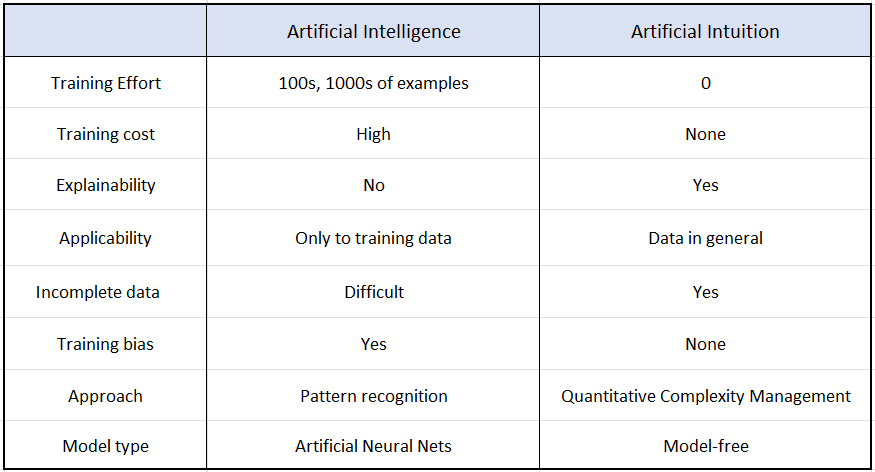
The following table provides a succinct summary of the differences between AI and AIu:
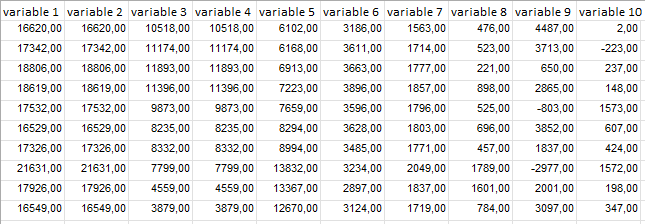
An extremely simple example of what Artificial Intuition can do and what would be (almost) impossible with Artificial Intelligence is the following (NB. when training with ML, one must already know the answer):
Which are the key variables in the following piece of data? What is the footprint of each variable in the data? No knowledge of context, data type, data characteristics is available.
The result provided by Artificial Intuition is this:
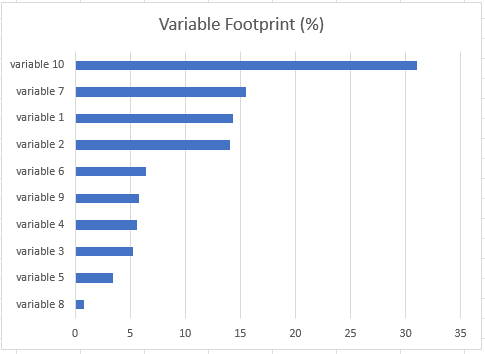
Variable 10 has the largest footprint – just over 30% – and therefore it is the most important variable within the given data set. Variable 8, on the other hand, has almost no impact within the space spanned by the data. Should the above data represent a situation requiring a decision, variable 10 would be the priority. Together with the following three variables (7, 1 and 2), the top four embrace approximately 75% of the problem at hand. All this is done without Machine Learning. Artificial Intuition has never “seen” this piece of data before.
We believe that a big step forward in machine decision-making will be made when Artificial Intelligence and Artificial Intuition are combined. The two happen to be “orthogonal”, to put it in mathematical terms. This makes them tremendously complementary.

Contact us for information.
 Artificial Intuition
Pingback: The Fusion of Artificial Intelligence with Artificial Intuition – Artificial Intuition