
First of all, let’s clarify what Artificial Intuition can do:
- Identify faults, anomalies or malfunctions in all sorts of systems, providing early warnings.
- Pinpoint concentrations of fragility and vulnerability. Basically this means indicating where things can break.
- Find key variables in complex systems to help prioritise in case of trouble, or when optimising and re-designing for certain functions.
Three key point need to be stressed:
- All of the above can be performed in the context of real time monitoring or off-line.
- No Machine Learning is necessary. Artificial Intuition doesn’t need thousands of examples. There is no training bias.
- Only data from a given system needs to be processed. Answers are not based on analysing similar cases.
The “intuition” in Artificial Intuition stems from the fact that, just like human intuition, or gut feeling, it ‘knows’ that something will go wrong before it actually does. This is not prediction. To predict an event is to specify (x, y, z, t). Artificial Intuition warns of an upcoming problem, indicating its potential causes.
When it comes to Artificial Intelligence, models like neural networks make probabilistic predictions based on training data. So there is also training bias.
Large Language Models (LLMs) sometimes generate incorrect or fictional answers (called “hallucinations”). This does not happen with Artificial Intuition.
Let’s consider an example.
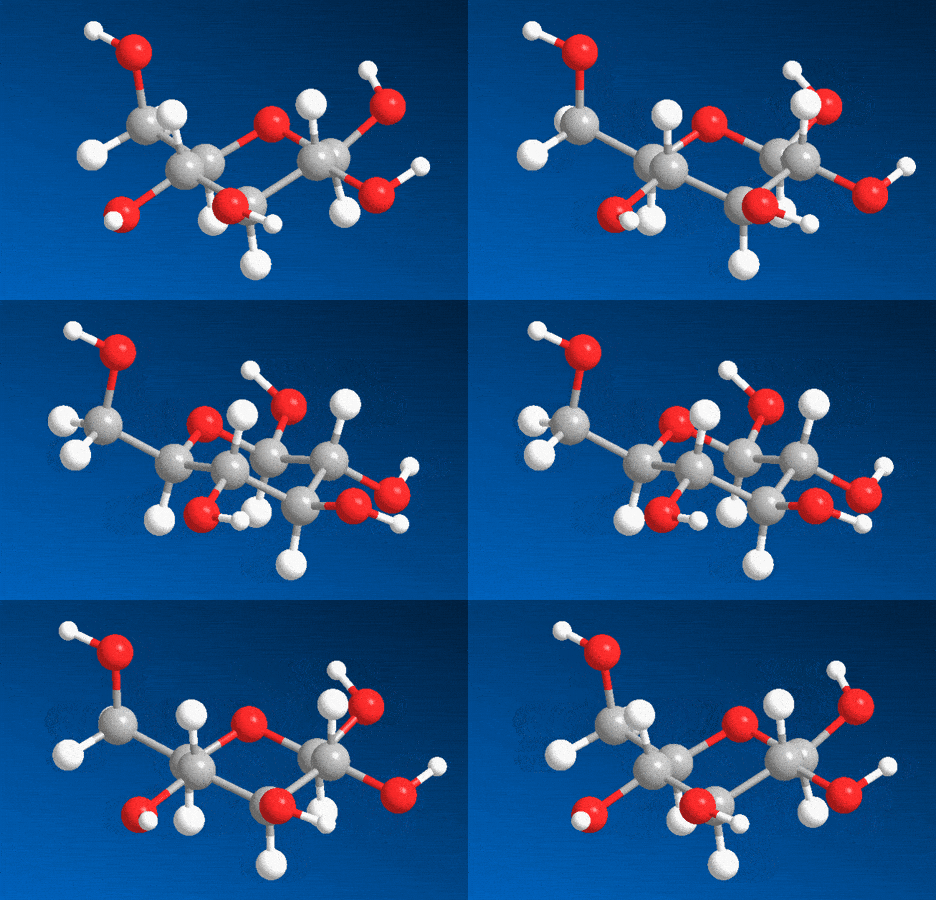
In a molecule, composed of a number of atoms, in order to identify the atoms driving its biological function, all Artificial Intuition needs to do is process the results of a Molecular Dynamics Simulation (MDS). MDS provides the relative motion of all atoms in a molecule as it vibrates. A few hundred nanoseconds of data are sufficient. As one can imagine, knowing which atoms drive biological function is crucial in drug discovery.
The above “MDS+Artificial Intuition” combination is an exercise of physics, which computes the answer. There is no training, no statistics, pattern recognition or probabilistic prediction. The answer is computed.

Contact us for information.
 Artificial Intuition
0 comments on “AI Guesses Solutions. We Compute Them.”