
In a recent blog on the massive blackout in Spain we have discussed how innovative monitoring of highly complex systems, such as the electrical grid, can produce early warnings of increasing grid fragility, giving time to intervene and, at least, to limit the damage. A subsequent blog discussed the dynamics and inherent fragility of super complex systems, and how this fragility cannot be spotted using conventional analytics or Artificial Intelligence.
This blog is not about the electricity grid or its complexity. The focus is on the complexity of the actual electricity production systems in certain European countries. The analysis is based on Development Indicator data available on the site of the World Bank. The countries in question are: Austria, Germany, France, Italy, Spain and Switzerland, while the indicators are:
- Electric power consumption (kWh per capita)
- Electric power transmission and distribution losses (% of output)
- Electricity production from coal sources (% of total)
- Electricity production from hydroelectric sources (% of total)
- Electricity production from natural gas sources (% of total)
- Electricity production from nuclear sources (% of total)
- Electricity production from oil sources (% of total)
- Electricity production from oil, gas and coal sources (% of total)
- Electricity production from renewable sources, excluding hydroelectric (% of total)
- Electricity production from renewable sources, excluding hydroelectric (kWh)
The above parameters are reported annually in the period 1960-2023.
Analysing the last available decade of data (1993-2023) for each country separately, yields the following results:

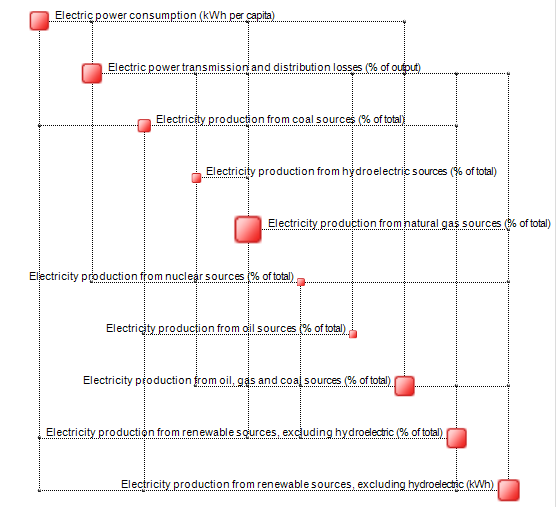
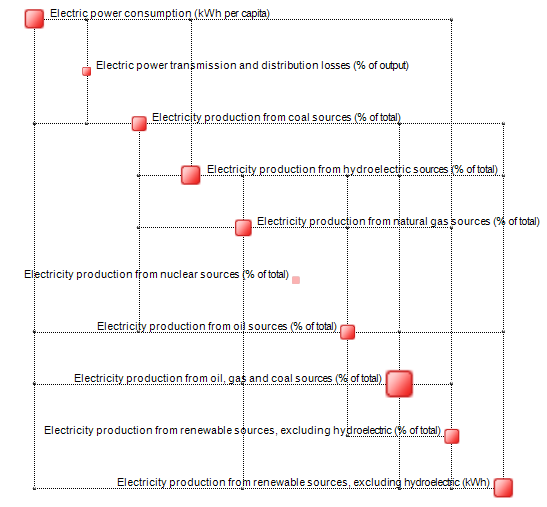
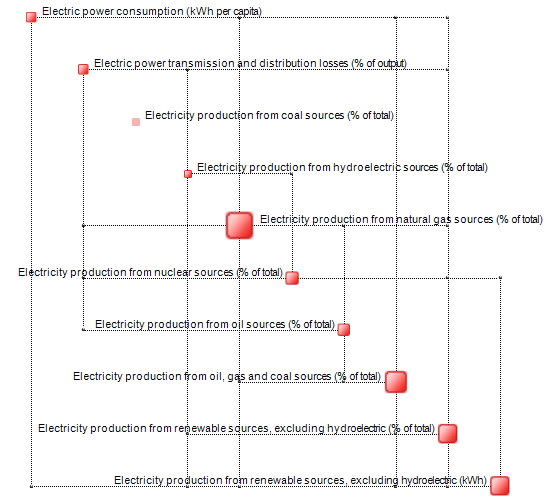
Spain’s energy production system is by far the most complex, followed by that of Austria, while those of Switzerland and France are on the other end of the spectrum. The size of the squares on the diagonal reflects the footprint of each variable on the entire system. These hubs indicate where criticalities could be concentrated.
Spain’s Complexity Map is shown below:
Spain
The map of Austria is next:
Austria
and that of Switzerland, as the one having the least complex energy production system:
Switzerland
Finally, the interesting case of Germany,
Germany
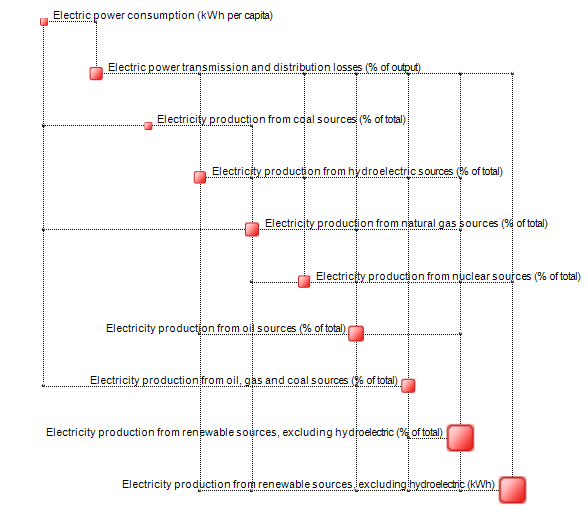
In the case of Germany, the impact of renewables on the complexity of its energy production system is dominant to say the least. Beware of the dunkelflaute.
Now, this information does not imply that the complexity of an energy production system drives that of the actual grid. However, as may be expected, the two complexities are certainly related. Does this explain the recent Spanish blackout? Maybe.
The above results have been obtained by analyzing each country seprately. However, since all electrical grids are linked, as countries import and export energy, a systemic analysis has been performed, considering all the six countries together, as forming part of one huge system of systems. The interesting result, reported below, is the impact of each country on the complexity of that huge super-system:
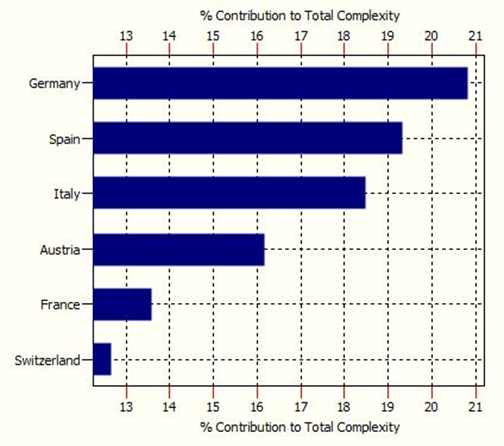
Germany is the greatest contributor, followed by Spain (surprised?), while Switzerland and France, once again, are at the lower end of the complexity spectrum. Now, this does not mean that the next big blackout will hit Germany, although if one had to bet, based on the above (very simple) analysis, Germany would be the logical choice. Besides, the German energy production systems has one major hub (one point of failure?) – renewables. Not only do they lack the inertia necessary to provide stability, they work only when Nature says so.
The last result also suggests that if Germany were to suffer a severe blackout, the consequences would be, potentially, greater than if the same happened in France. However, given the immense complexity of the Continental Europe Synchronous Area, which supplies over 400 million citizens, such statements must be taken with a bag of salt. In 2003, for example, Italy suffered a 12-hr blackout which commenced in Switzerland.
What can be done to prevent massive blackouts? There is little that can be done in terms of analytics, Artificial Intelligence or other techniques. Due to the sheer complexity, such events are luckily very rare, and are all unique. There is no patter to recognize here. Machine Learning won’t work.
In the meantime, over the decades, the resilience of this combined electricity production system has been going down:
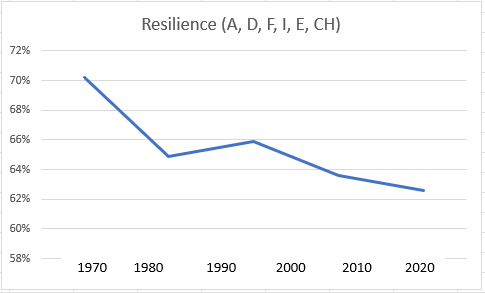
It went down from around 70% in the 1970s to 60% today. Where will this take us? Are blackouts inevitable, just like the crashes of the financial markets? How many of such Black Swans can we, and our economies absorb? What can be done?
In the case of systems with similar dimension and complexity, there appears to be one approach – monitoring of complexity and resilience using innovative techniques such as the QCM (Quantitative Complexity Management) of key locations, systems and equipment in the national electrical grids, and looking out for any complexity peaks or sudden variations thereof. These provide formidable early warnings, that conventional, and even the most recent analytical techniques are unable to provide. In fact, over the past twenty five years, on average the has been one major power outage per year, see list.
“According to industry reports, power outages cost the US economy between $18 and $33 billion annually…. Power disruptions pose substantial financial burdens for businesses, with one in four companies in the U.S. experiencing monthly outages, amounting to an annual cost of $150 billion to the economy.” (source).
While total outage prevention is not possible, mitigation strategies, based on complexity monitoring via QCM are available and ready for immediate deployment.

Contact us for information.
 Artificial Intuition
Pingback: Der spanische Blackout – und wer als Nächstes im Dunkeln stehen könnte • CPS Schliessmann