

A recent article: “
2023 J.D Power’s Initial Quality Study Finds That Cars Are Getting More Problematic
states:
“Really, it’s all the connectedness in cars and tech features that have contributed steady uptick in issues. J.D. Power says that driving experience issues has stayed flat over the years. The biggest problems are coming from the features, controls, and displays category and the infotainment category.”
Complexity of the electronics in cars is growing as companies compete to turn cars into computers and gadgets on wheels that rely on hundreds of sensors and millions of lines of code.
The quality ranking is shown below.
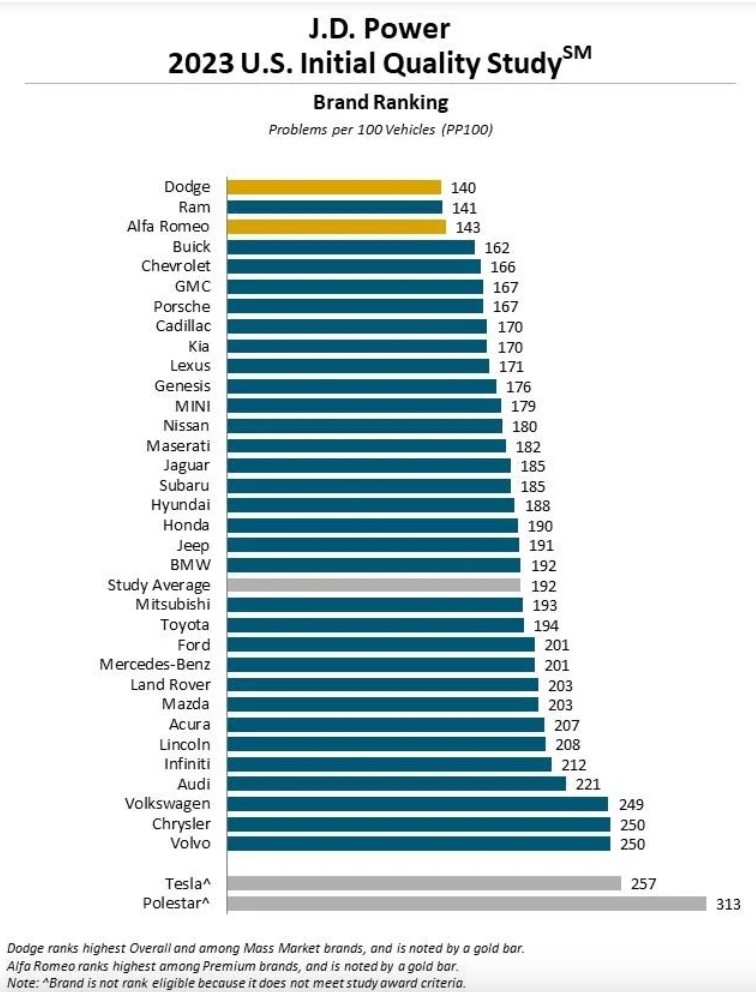
Alfa Romeo, who concentrates on making great cars with great engines, not ipads on wheels, ranks second, better than Porsche. Maserati beats Jaguar, BMW, Mercedes or Audi, even Toyota or Tesla.
The Principle of Fragility, coined by Ontonix, states that:
Complexity x Uncertainty = Fragility
Where:
Complexity – overall complexity of a product or system
Uncertainty – uncertainty in operating conditions, manufacturing quality, SW bugs, erroneous sensor readings, tolerances, operating skills, etc., etc.
Fragility – the outcome
What this means is the following:
A highly complex product in an uncertain ‘enviroment’ will behave as fragile
A huge chunk of the ‘uncertainty’ in the context of modern hi-tech automobiles is that emerging from onboard software and its immense complexity. Millions of lines of code will have hundreds even thousands of bugs. Feed this software with imperfect sensor readings and a myriad of problems crop up. Some may lead to accidents, some can just cause expensive damage. The bottom line is:
Unless product complexity is taken into account already in the design phase, it will inevitably reduce overall quality
In other words, low-quality high-tech products will behave as low-tech products. This sensation will increase with increasing complexity. This is inevitable.
The ideal place where to start attacking the problem is at the CAE level, by incorporating uncertainy and Complexity Management from day one. This is true not just for the structural aspects, but also electronics. However, this constitutes too big of a challenge for CAE vendors, mainly due to cultural barriers and inability to (really) innovate. Sophisticated collaborative, distributed working environments, super-dense FE meshes, coupling CFD and structural mechanics, process integration or optimisation are all fine, but there is much more to engineering great products than that.
An experienced engineer will always seek simplicity in his designs and not just because they are aesthetically more pleasing and elegant. Today, however, CAE vendors are unable to embed this philosophy into their SW products. One wonders if they ever will.
NB. The Principle of Incompatibility (L. Zadeh) states that:
High precision is incompatible with high complexity
In plain English: a super complex product will never behave “precisely”. It will never work in a fully predictable way. It will inevitably deliver surprises, and more of them as its complexity grows.
 Artificial Intuition
Excellent analysis resulting from the great experience of Ontonix on this subject.
LikeLiked by 1 person
Pingback: How Much AI Can a Car Handle? – Artificial Intuition