

Complexity is defined formally via the following equation:
C=f(S; E)
where S stands for structure, E is entropy and f is a matrix operator. C is a scalar while S and E are both matrices. The equation shows how complexity captures the intensity of structure-entropy and entropy-structure transformations that accompany physical processes and, in particular, the corresponding information flow. Physical processes involve the transfer of mass, energy as well as information. Via the above equation, complexity establishes a bridge between physics and information theory and is therefore of paramount importance.
A complexity metric is meaningless unless it is bounded. This is the case of the Ontonix metric. Both bounds have interesting significance from the standpoint of physics but it is the upper bound – known as critical complexity – that is of particular interest. Systems that function close to their critical complexity threshold are fragile, hence vulnerable. They are also unpredictable and chaotic. For this reason, the critical complexity limit should be known for every system, as well as its current, operating complexity. It is the difference between critical complexity and complexity that has a direct impact on resilience, the capacity to withstand shocks.
In order to understand better what happens at critical complexity, we take a look at a wave and its dynamics.
When a wave starts to form, its structure emerges. The amount of disorder (entropy) is quite small, and the structural component dominates the dynamics, see below.

As the wave evolves, the component of disorder starts to become more evident. Structure and entropy both participate in the dynamics.

When disorder takes over, it starts to erode structure. The situation is now definitely not deterministic.
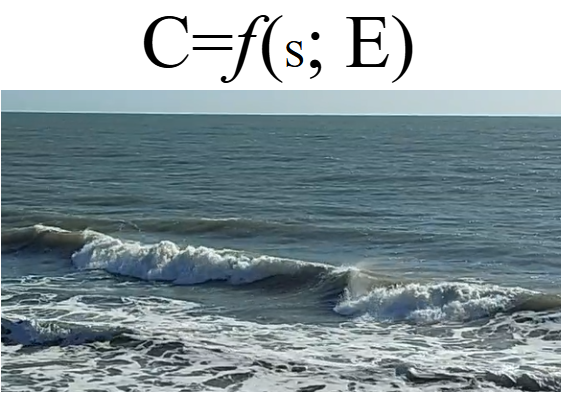
Finally, structure has disappeared and all we’re left with is plenty of disorder. This is symbolically indicated by S=0 in the image below.
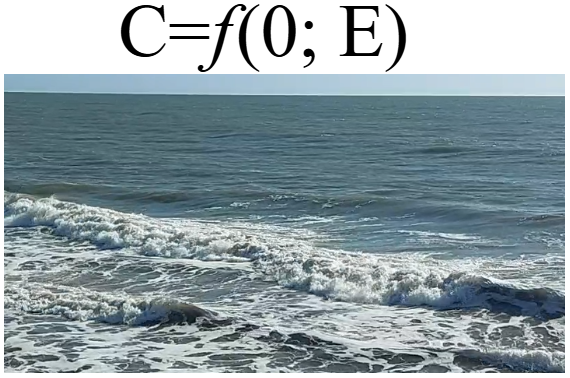
Evidently, the most favourable condition is when disorder is low and structure is resilient. With structure in place, one may think of controlling a given system or simply managing it. Imagine running a company with unstructured, ‘soft’ processes and informal or fuzzy communication protocols.
If you are running a system, such as an energy network, a telecommunications network, logistics, supply chains, road and railway networks, manufacturing or chemical processes, assembly lines, or the like, it is a great idea to:
- Know how complex the system in question is,
- Know its critical complexity,
- Know its resilience,
- Be able to pinpoint its complexity (fragility) hotspots.
If you know none of the above, you just probably have a huge control room with tens of screens and specialists sitting in front of them watching if values are within specs. Good luck.
PS. Our annual analysis of the hundreds of thousands of World Development Indicators from the World Bank, show that we, the Global Society, are about 25-30 years away from an un-structured, chaos dominated society. Something that looks quite like the last image in this blog.
Waves filmed on Patagonia coast in Argentina.


what informed their “specs” in the first place?
only resilient processes can meet even the so called specifications.
LikeLike