
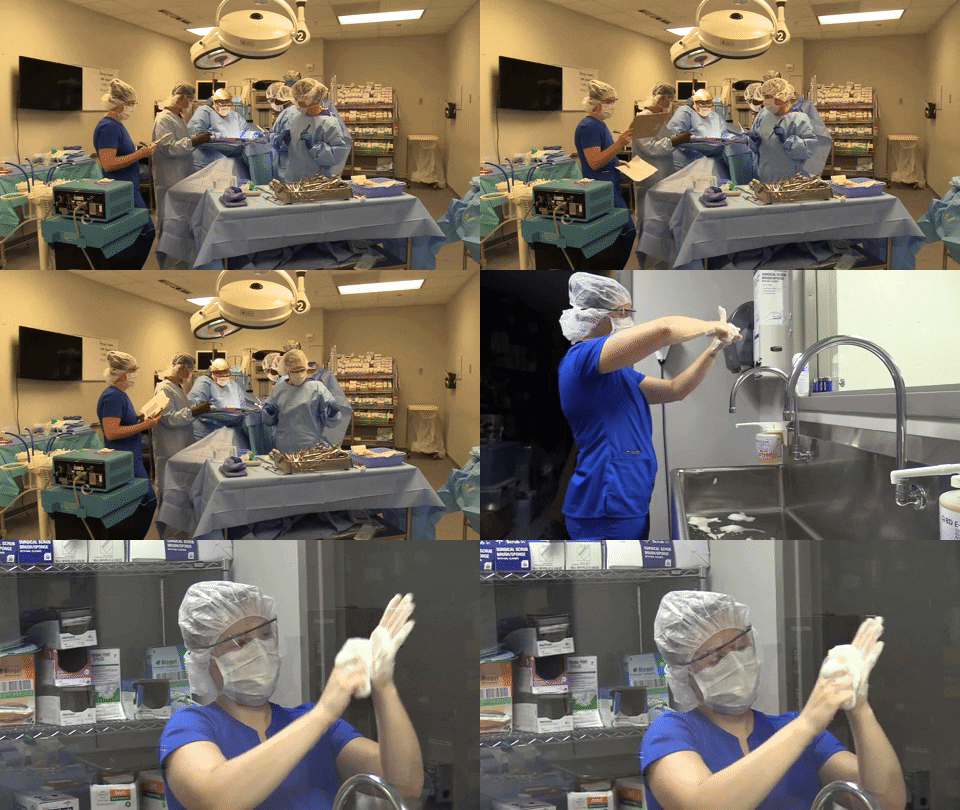
Here are some facts about what Artificial Intuition can and cannot do in Operating Rooms during surgery and in Intensive Care Units:
Artificial Intuition is a real time early-warning and risk-screening technology, rather than a diagnostic tool.
Artificial Intuition does not use Machine Learning. It is powered by Quantitative Complexity Management (QCM) to analyse the structure, complexity, and interdependencies within physiological data.
It uses data only from a specific patient, not statistical data from databases.
It does not require a pre-existing dataset or historical patient data to begin analysing the patient. Its analysis can commence once physiological data from the monitored patient becomes available.
The information input begins when the patient starts being monitored; Artificial Intuition analyses the incoming physiological data as it is generated.
It does not need to be trained on that individual patient’s previous history in order to begin identifying changes in their physiological complexity.
It continuously analyses multiple physiological parameters together in real time, assessing the patient as a whole physiological system rather than looking at individual monitor readings in isolation.
It analyses the interdependencies and information flow between physiological parameters, identifying changes in the underlying structure of the patient’s physiological data.
It can identify anomalies and pre-crisis changes in physiological complexity, providing an early warning that a patient is moving towards an unstable or critical state.
It can detect these changes before deterioration is necessarily apparent through conventional individual parameters.
It generates an overall measure of the patient’s physiological complexity and associated risk.
It produces a Complexity Profile, which identifies and ranks the monitored parameters according to their contribution to the patient’s overall complexity.
It can indicate which physiological parameters are contributing most strongly to a change in complexity at the time an early warning is generated.
It can identify relationships and interdependencies between those parameters, rather than simply reporting whether individual values are high or low.
It has demonstrated the ability to identify patients at increased risk of subsequent postoperative complications using physiological data collected during surgery.
It can also be used to monitor changes in physiological complexity following an intervention or treatment, providing a quantitative measure of response.
Artificial Intuition does not diagnose the underlying clinical condition responsible for an alert. For example, it does not independently determine that a patient has sepsis, bleeding, cardiac failure, or another specific diagnosis.
It does not establish that a particular parameter is the clinical cause of deterioration. Rather, it identifies in real time which parameters are contributing to the change in the complexity of the physiological system.
It does not prescribe treatment or determine the appropriate clinical intervention.
The clinician remains responsible for interpreting the early warning and contributing parameters in the context of the patient’s overall clinical picture and determining the appropriate clinical response.
Artificial Intuition can indicate that something significant is changing, how early that change is occurring and which monitored parameters are contributing most strongly to it- the clinician determines what that change means clinically and what action should be taken.
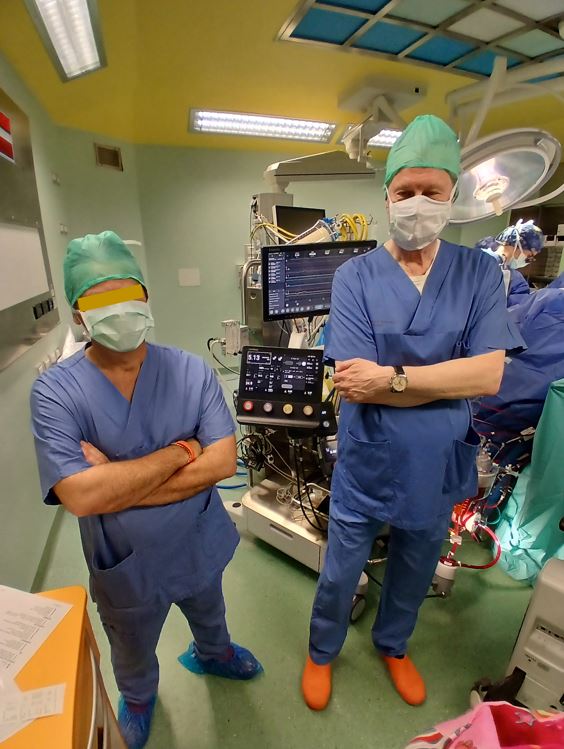
Ontonix founder, Dr. J. Marczyk, assisting open heart surgery in cardio-pulmonary bypass.


0 comments on “Artificial Intuition in Operating Rooms and Intensive Care Units.”