
Artificial Intuition, as defined by Ontonix, is 4th-generation AI technology that doesn’t require historical data and training. Instead, it examins a system’s complexity and dynamics in real time based only on recent data. It measures the intricacy of processes on the basis of physics and information theory, detects anomalies as sudden disturbances of structure, and identifies threats immediately with no black-box effect.
Complexity is the new risk.
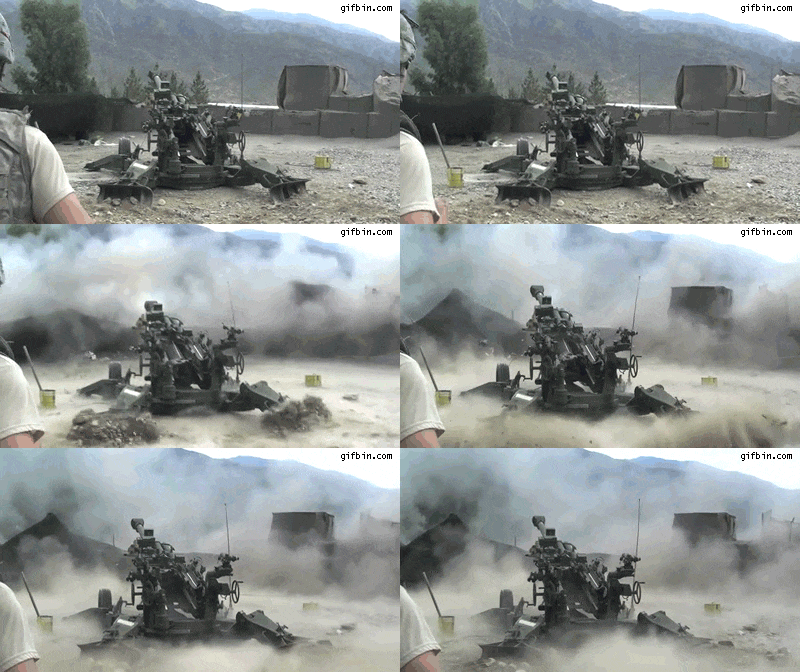
A tank, a satellite, a power grid: each integrates hundreds of electronic modules, sensors and controllers. Complex platforms do not fail suddenly and for one reason. Failure grows as a subtle change in the network of dependencies between dozens or hundreds of signals. No single sensor sees it. No threshold rule detects it. Yet the signal exists.
Ontonix is not another AI company, not a predictive-maintenance vendor and not a single-signal anomaly detector. We provide a layer that tells a machine how close it is to losing systemic resilience and which elements are responsible, and which assesses the consequences of an AI system’s decision before it is executed. We deliver the solution on hardware or software.
Complexity as a KPI. Anomaly as a signal.
Quantitative Complexity Management (QCM), developed over more than two decades and applied in defence, aviation, automotive, medicine and pharma, does not measure the value of individual sensor outputs. It measures in real time the structure of mutual dependencies between all sensor outputs. When a component degrades, the distribution of complexity shifts before any threshold is crossed. That is the pre-alarm. In normal situations, when all works well, the system indicates which variables are potentially critical and where do current priorities lie.
AI gives machines intelligence. We give them intuition.
Ontonix delivers a resilience layer for mission-critical platforms and autonomous systems. We continuously monitor the complexity and resilience of a platform as a whole, pointing to critical or potentially critical elements, recognising an approaching failure before any single sensor crosses a threshold. No training is needed. And explainable results.
Artificial Intelligence and Artificial Intuition: A Winning Combination.
For a given query, AI determines the most probable solution based on prior training. There may be numerous solutions that are “close” but only the most likely one is provided. What Artificial Intuition accomplishes is to examine all those highly likely solutions and selects the one that is the least complex. Just as a human would do. The consequences and benefits of this are easy to imagine. Less complex solutions are easier to understand, to implement, and offer evident benefits from the standpoints of operations, maintenance, or repair. As mentioned, high complexity is the new risk and AI alone can compound it immensely. Artificial Intuition provides a vital layer that can keep this risk under control.


0 comments on “Artificial Intelligence and Artificial Intuition: A Winning Combination.”