
SCADA (Supervisory Control and Data Acquisition) is an industrial control system architecture used for high-level supervision and control of geographically dispersed assets. It enables operators to monitor data from field sensors and remotely issue commands to equipment from a central location, optimizing efficiency, safety, and reliability in complex processes .
Leaders in SCADA systems are Siemens, through its SIMATIC WinCC series products, it provides highly scalable SCADA platforms and continuously expands its edge computing applications, and Schneider Electric with its EcoStruxure platform and Geo SCADA solutions which are widely used in energy and infrastructure sectors.
Core Architecture and Components
A SCADA system typically comprises several integrated subsystems that work together to bridge the physical and digital worlds:
Human-Machine Interface (HMI): The graphical user interface (GUI) that presents process data to operators. It allows them to visualize trends, acknowledge alarms, and issue control commands (like changing setpoints).
Remote Terminal Units (RTUs) / Programmable Logic Controllers (PLCs): Microprocessor-controlled devices located in the field. They connect directly to physical sensors and actuators, converting electrical signals into digital data for transmission and executing control commands received from the master station.
Communication Infrastructure: The network (wired or wireless) that transfers data between the remote field devices and the central supervisory system. This allows for control over long distances.
Supervisory (Master) Station: The central computer system that gathers data from the RTUs, processes it, and displays it on the HMI. It serves as the “brain” where operators supervise the entire operation.
How It Works
The operation of a SCADA system follows a continuous loop of data acquisition and supervisory control:
Data Acquisition: Sensors at the plant or remote site measure physical parameters (e.g., pressure, temperature, flow). RTUs or PLCs collect these raw signals, digitize them, and send them back to the master station via the communication network.
Supervision & Analysis: The master station software processes the incoming data. The HMI displays this information in real-time, allowing operators to monitor the health and performance of the system. If values exceed predefined thresholds, the system triggers alarms.
Control Actions: Based on the analysis or operator input, control commands are sent from the master station back through the network to the specific RTU/PLC. The device then actuates the physical equipment (e.g., opening a valve, starting a pump) to adjust the process.
Key Characteristics and Applications
SCADA systems are distinct from other control systems (like DCS) primarily because they are designed for geographically distributed processes rather than processes contained within a single factory.
Primary Roles: They essentially serve two main functions: communicating information from physical sensors to a central point and facilitating physical manipulations of remote components.
Common Applications: They are widely used in industries where assets are spread out over large areas, including:
Utilities: Electrical power grids, water distribution, and wastewater management.
Oil and Gas: Monitoring pipelines and subsea production systems.
Infrastructure: Transportation systems (rail, traffic control) and gas pipelines.
Modern Trends
Modern SCADA systems are evolving from proprietary, hardware-dependent architectures to more open and interconnected systems. Key trends include:
Integration with IoT: Adoption of low-cost IoT gateways and sensors to improve data aggregation efficiency and reduce costs, particularly in manufacturing sectors.
Standardized Protocols: Increasing use of open standards like OPC UA to improve interoperability between equipment from different manufacturers and to enable secure machine-to-machine (M2M) communication.
Distributed Processing: A shift toward distributing processing power closer to the edge (smarter RTUs) and using standard software platforms to increase flexibility and reduce obsolescence risks.
Integrating SCADA systems with QCM-Artificial Intuition
Integrating Ontonix’s QCM-Artificial Intuition with SCADA systems is quite straightforward, and its core value lies in filling the gap where traditional SCADA can only perform threshold alarms and cannot detect “systemic anomalies”. It does not monitor whether a single sensor exceeds limits, but rather monitors the dependency structure between all sensor signals in real-time, detecting system fragility before physical failures occur and issuing early warnings.
How to Integrate
Integration can be achieved through two approaches, both with corresponding hardware/software foundations:
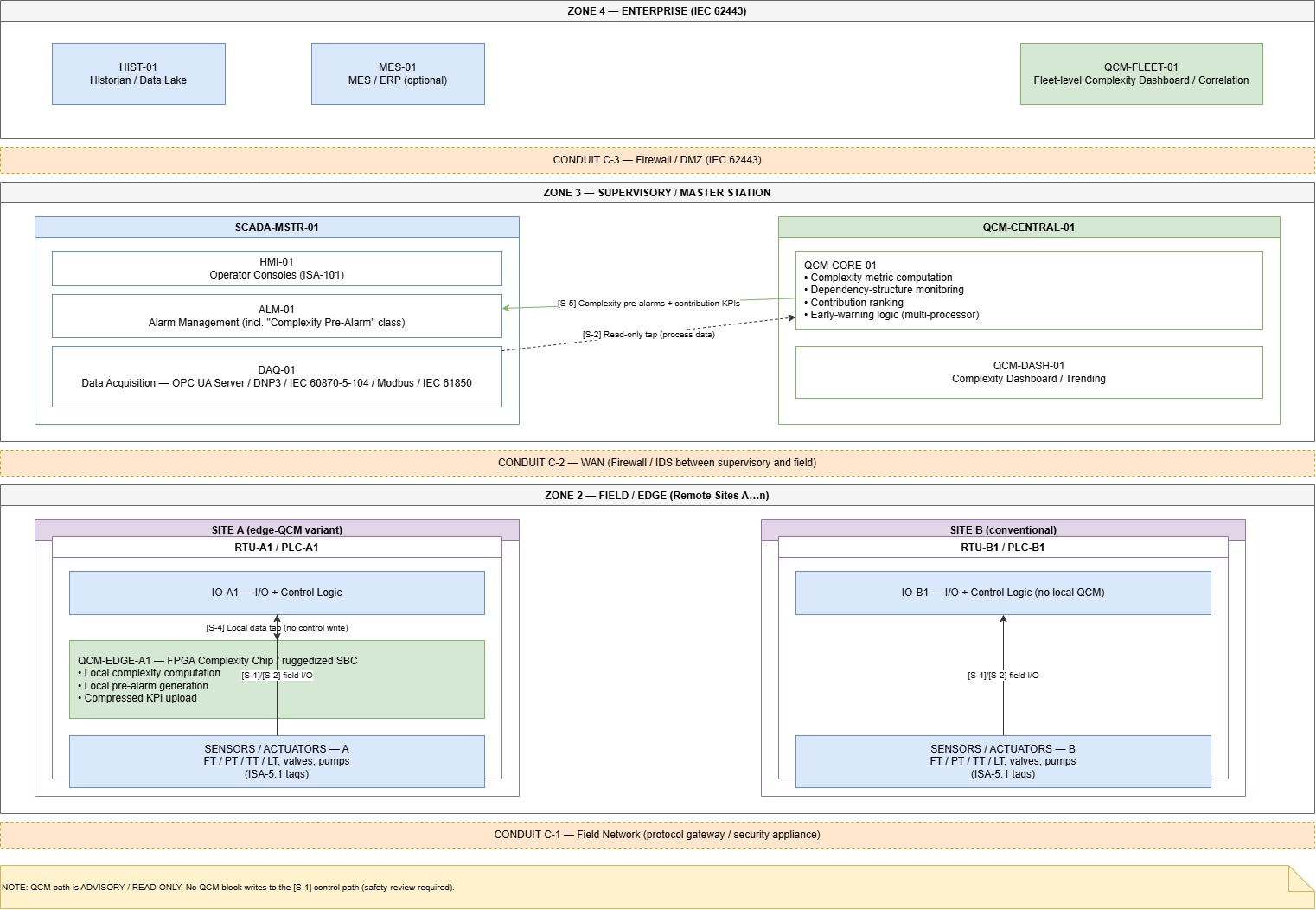
Software Layer Integration (Non-Intrusive): Deploy QCM algorithms on the SCADA master station server or independent analysis server, reading real-time data streams from the SCADA historian or OPC server. Ontonix’s algorithms are model-free, require no training data, and can directly process raw data streams containing noise and missing values. The 2025 multi-processor version supports parallel processing of large-scale high-frequency data, meeting real-time requirements.
Edge/Hardware Integration: Utilizing Ontonix’s FPGA “Complexity Chip” solution, deploy QCM computations directly at RTU/PLC-side or near field devices. This approach is particularly suitable for remote sites with limited bandwidth (such as pipelines, substations), where only pre-alarm signals or complexity indicators need to be uploaded, reducing backhaul data volume.
Core Benefits: From “Alarm” to “Pre-Alarm”
Traditional SCADA alarms are triggered when a variable exceeds a set threshold, by which time degradation has already occurred. QCM provides different information:
Systemic Early Warnings: QCM monitors the “complexity” of the system—that is, the structural tightness of inter-variable relationships. When a component begins to degrade, the dependency structure changes before any single sensor exceeds limits, and complexity metrics will show abnormal fluctuations.
Fault Source Localization: QCM can not only alarm but also calculate “complexity contribution” for each monitored variable, indicating which specific measurement point or component is the primary driver of anomaly evolution, assisting maintenance personnel in targeted inspection.
No Training Data Required: Unlike machine learning methods, QCM does not require collection of historical fault samples for training. In SCADA scenarios, many critical failures are rare events, making training sets often unavailable. QCM is physics and information theory-based, requiring only real-time data to operate.
Edge Computing Feasibility
QCM-Artificial Intuition is well-suited for edge deployment. Ontonix has previously launched the “Complexity Chip” based on FPGA technology, explicitly designed for ultra-fast complexity monitoring of mission-critical equipment, with channel counts scalable from tens to 1000 channels, and capable of operating independently on mobile platforms or embedded devices. The 2025 multi-processor version further enhances processing capabilities for large-scale data streams, with performance scaling nearly linearly with core count—meaning processing capacity can be increased by adding cores at the edge without replacing the architecture.
The scheme below illustrates an implementation of QCM in a SCADA framework (click to enlarge)
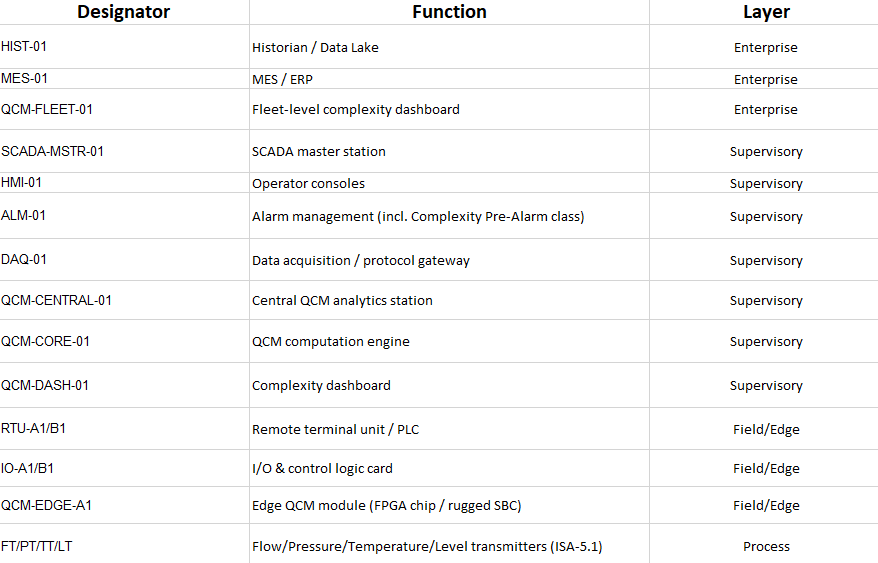
The various modules are:


0 comments on “Integrating QCM-Artificial Intuition with SCADA Systems”